W123 300D – Climate Control Part I
The Background
When I did the test drive for my car the seller let down the windows, one wouldn’t go back up all the way … great start. When I pointed out that the air from the vents was coming out red hot (on a 30ºC day) despite the climate control being set to 18ºC, he said that he preferred to just drive with the windows down … sure boss, I suppose that he preferred that the shock absorbers were worn out too.
Let’s first lay out the 3 kinds of climate control systems used by Mercedes in the W123 chassis over the years, these are best characterised by the control panel in the centre console. They are as follows:
- “Heating/Ventilation and Air Conditioning System I”, brought in in model year 1977 on the 230 and 240D. This system had your normal 3 rotary dials and a button for A/C.
- “Air Conditioning System II Automatic Climate Control”, brought in model year 1977 also, in the 300D/CD/TD and 280 E/CE. This system can easily be identified from the vertical column of push buttons in the control panel.
- “Air Conditioning System III Automatic Climate Control”, brought in model year 1983, in the 300D/CD/TD (Turbo) and 280 E/CE. This system can easily be identified from the horizontal row of push buttons in the control panel.
My Situation
I have a 1985 300D with system III. All of these systems (and many other functions in the car) are controlled by vacuum. So when I saw this under the bonnet and the green & yellow vacuum line (for the climate control) swinging in the wind I knew that there must have been some problems. I plugged that vacuum line in and then my engine wouldn’t stop when I turned it off1.
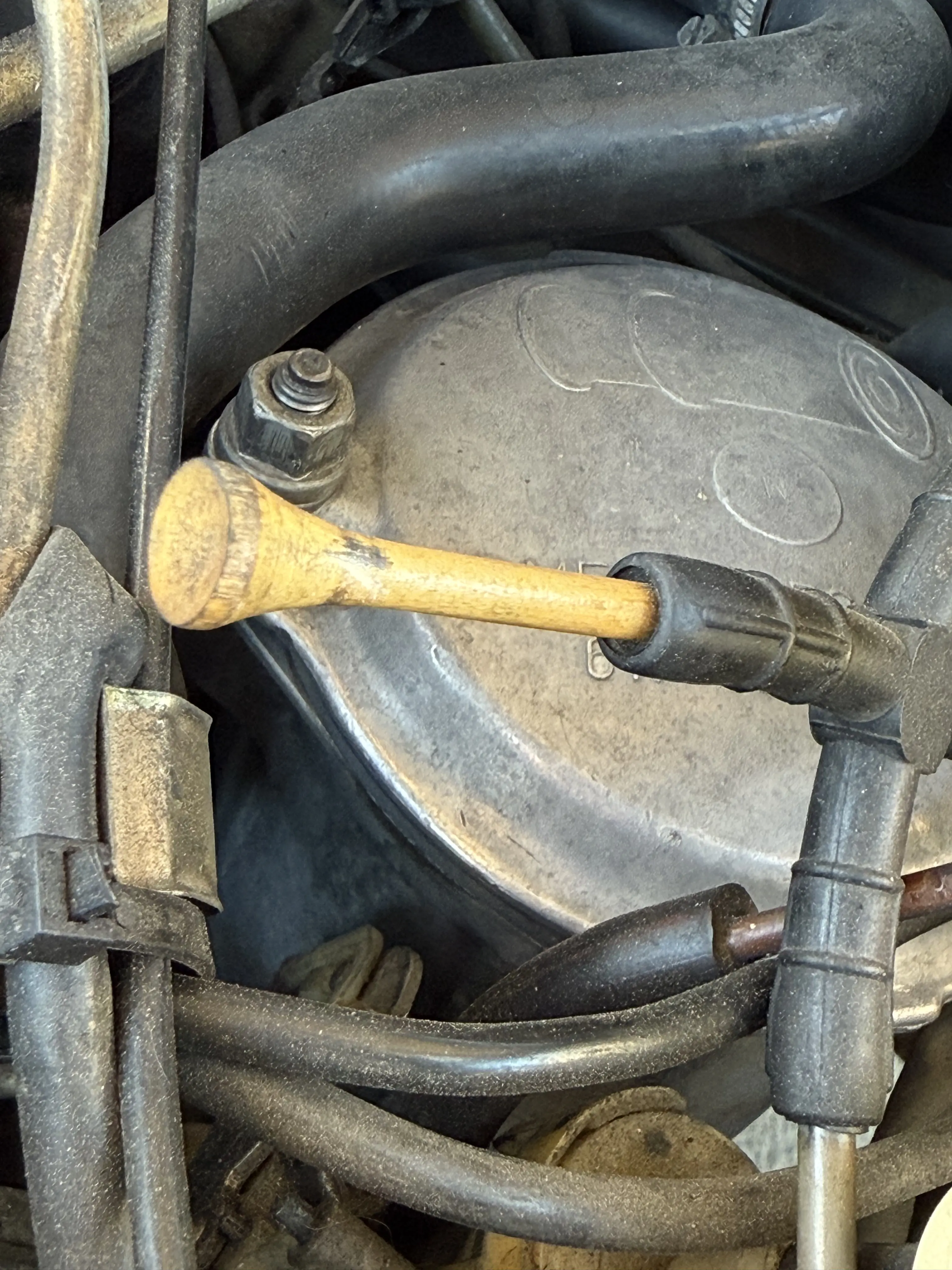
An essential part of the Mercedes roadside toolkit.
I started my quest by pulling off the kick panels under the dashboard and pulling the control panel out. I found that the other end of this green & yellow line was also disconnected, at this moment I did get a little bit excited that this would be the big fix, but alas I was just getting going. At least that explains why my engine wouldn’t shut off – I’d created a massive vacuum leak!
I came across another open vacuum line too this time in the centre console, a line that should have been connected to the main distribution block.
The Bigger Vacuum Picture
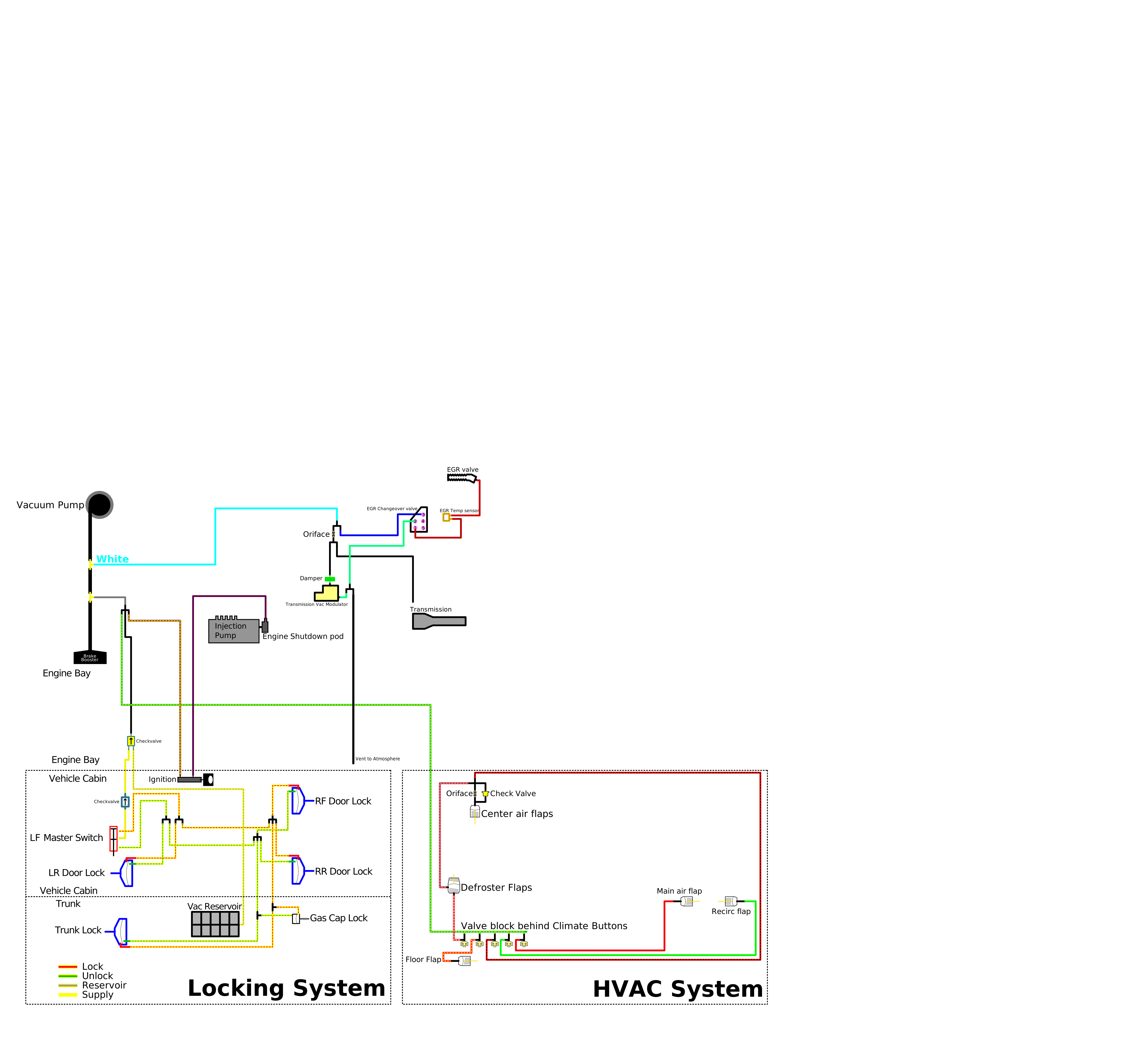
I’ve mentioned vacuum lines a few times already, what I should do is show a functional diagram of the system on my car. Here is a clear and high level diagram2 of what we’re dealing with, this was put together by Tom from trythistv.com who has extensive YouTube videos that covering the W123 from the backyard mechanic perspective. Tom notes that his car has been messed with and that this diagram is pieced together.
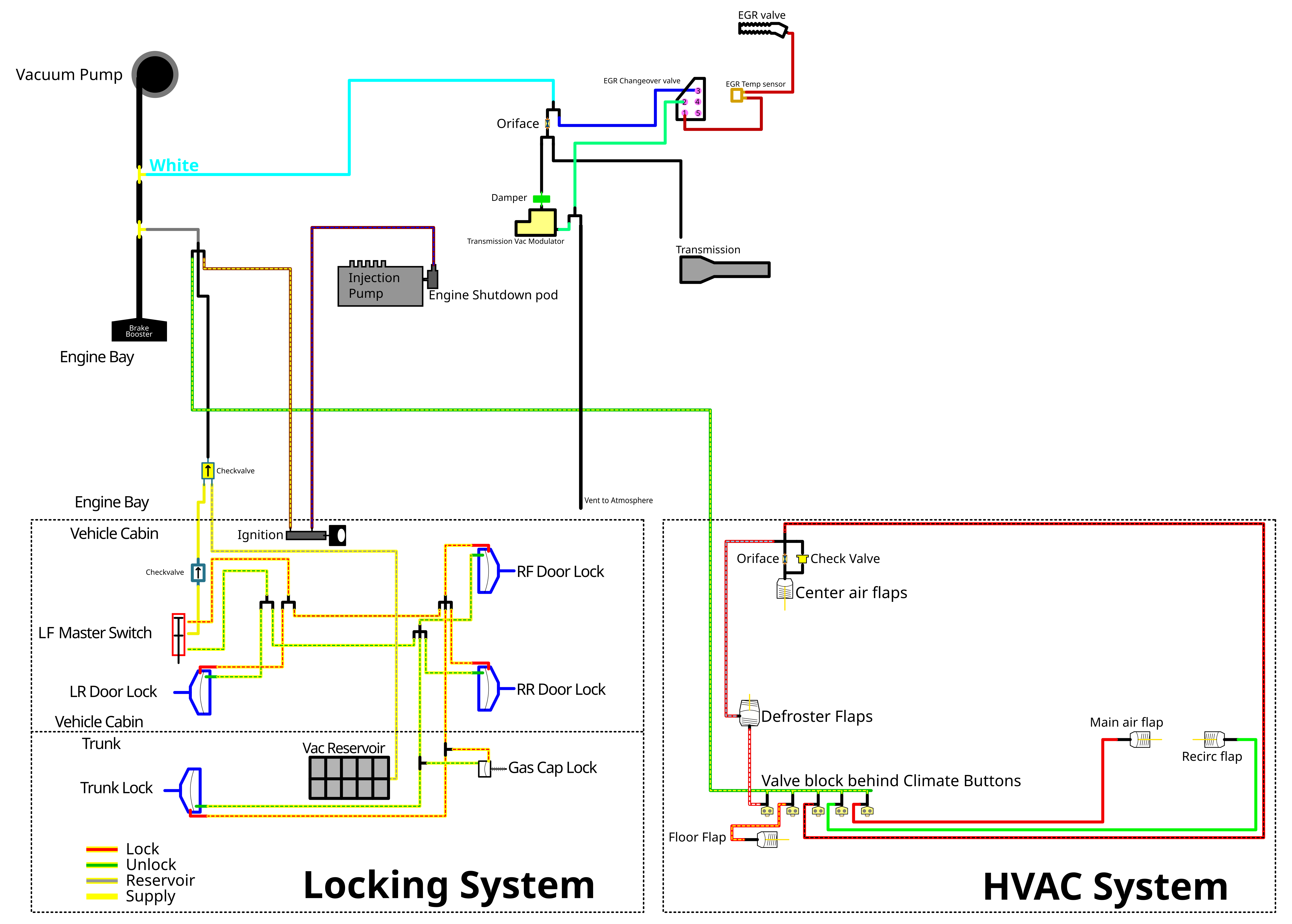
Vacuum diagram put together by Tom from trythistv.com
Back to Hot Air
You might be wondering how I had this red hot air if there were these massive vacuum leaks, well the Mercedes engineers were clever and the windscreen defroster vents are normally open, so even when the vacuum subsystem is in a failure state, you can still clear your windscreen.
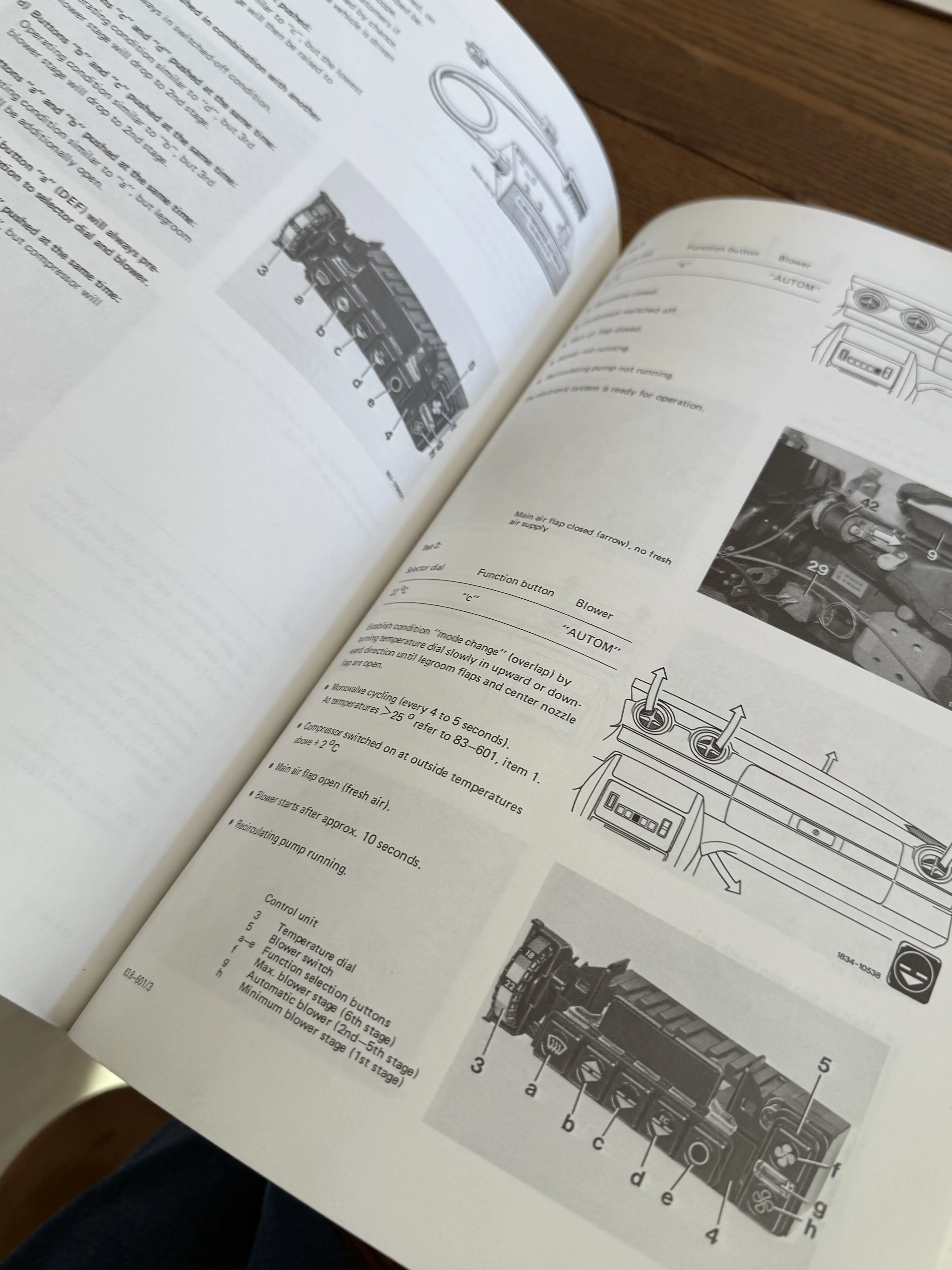
Plugging vacuum lines back in did make my buttons work and air come out of various vents, this was good but it was still red hot. I’d not really been worried by this because it was winter, but considering we’ve had the warmest winter for fifty years cold a/c is back on my mind. One night I was perusing eBay as one does, and stumbled upon a service manual for the W123 climate control systems for a good bargain. This book covers all three systems, the components in the cabin and in the engine bay, how to test each system just by using it and observing results, as well as using test equipment, then there’s the circuit diagrams showing wire colours and the vacuum diagrams that show where the vacuum is routed for each function. Over all this is a practical bible for anyone trying to reverse engineer these systems.
Some samples from the book
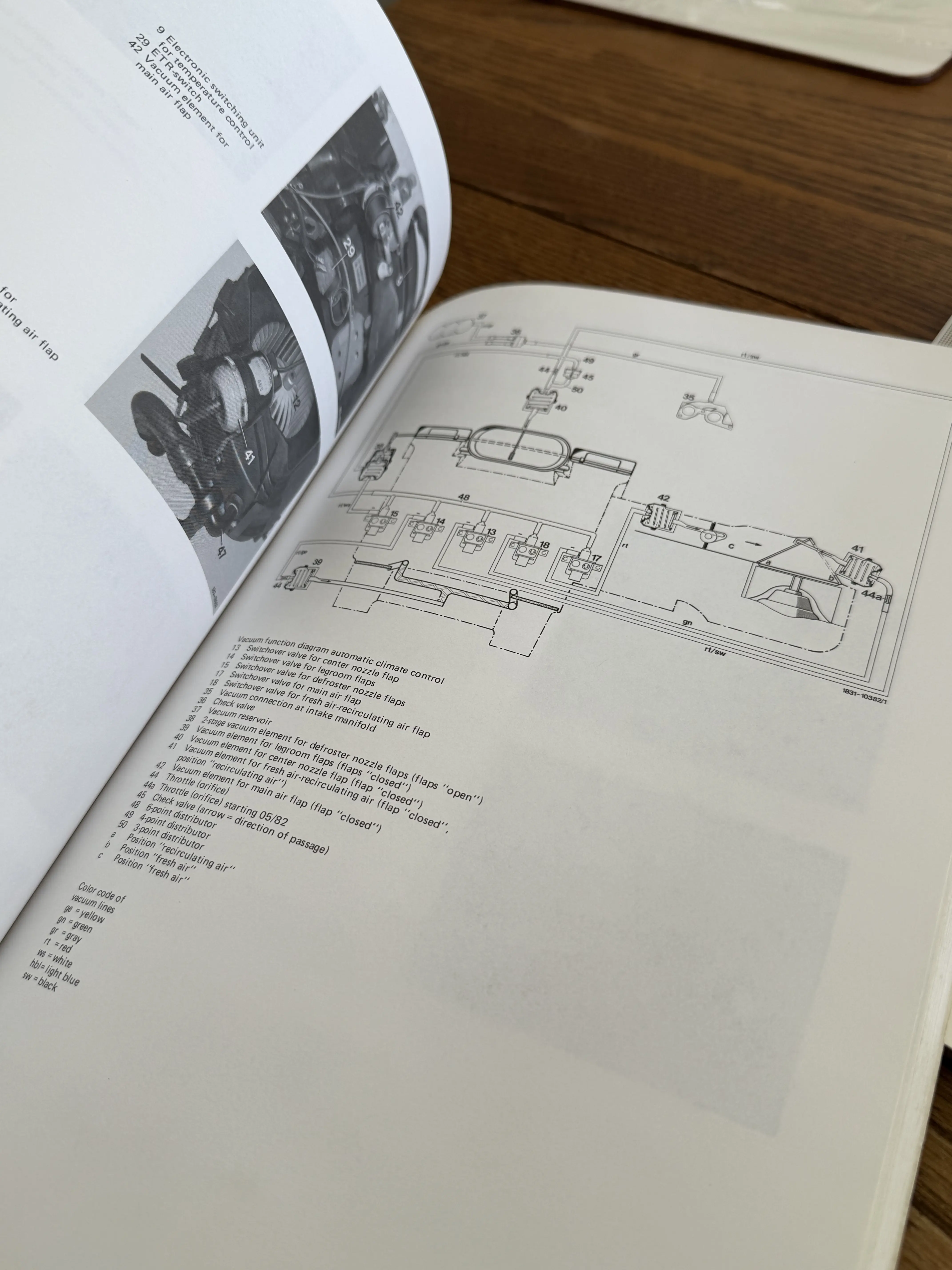
When I started going through this book I learnt a lot more about how this system works. I felt that the temperature problems must be caused by either the potentiometer used in selecting the desired temperature or the thermistor that conveys the cabin temperature to the climate control computer, or a problem with the climate control “computer” itself3. I started with the potentiometer on the switching unit.
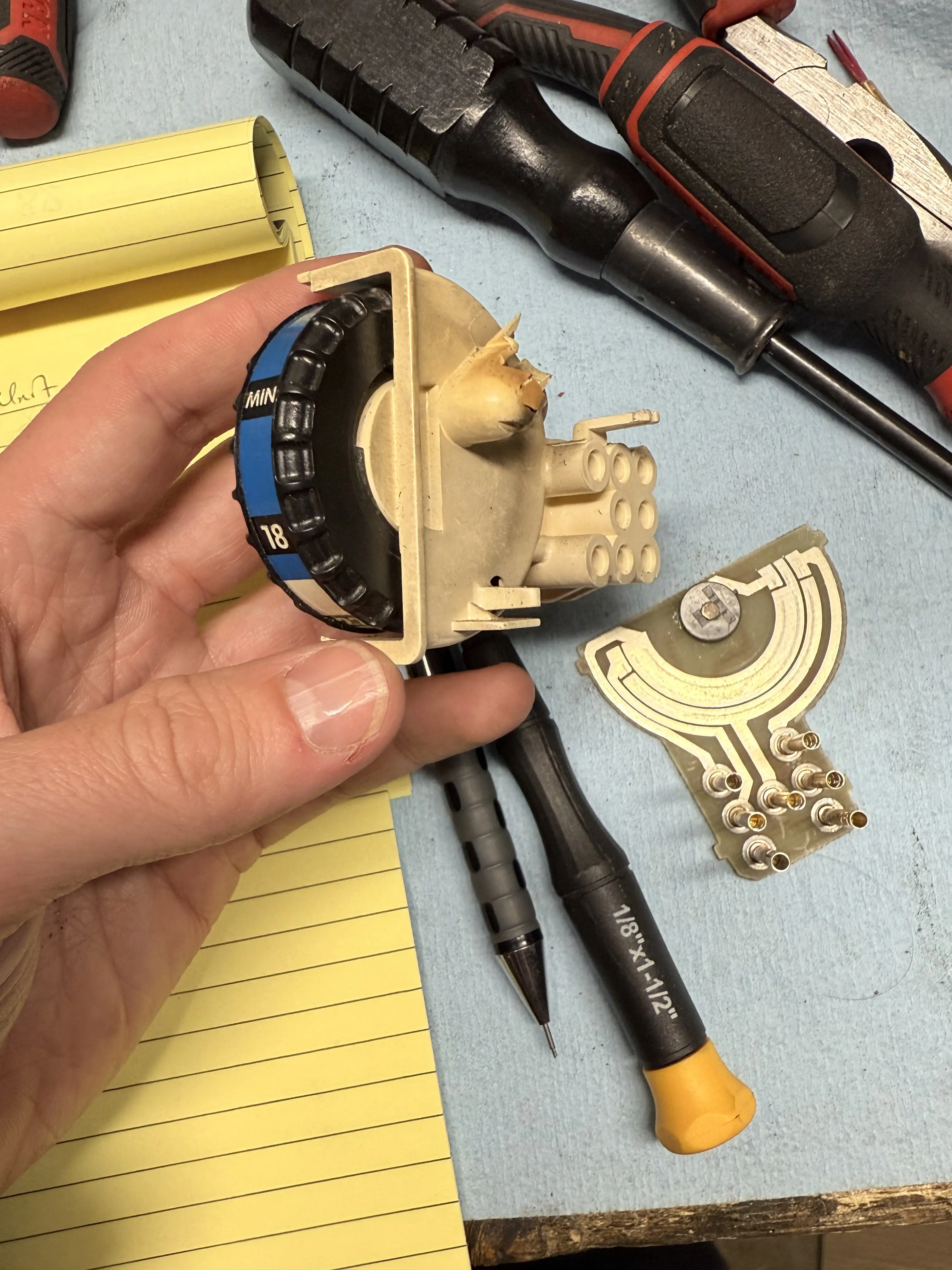
The housing with the PCB on the bench in background.
At the heart of this is a 10K potentiometer, made by RUF (now Bourns), with two little switches at either end to convey min temperature desired or max temperature desired. Nearly all the traces on the side of the board, visible in the photo, are actually nothing to do with the potentiometer, the exception being one trace coming from the potentiometer to which is complete when the selector is in the min position. I had thought that this potentiometer was out of tolerance, it’s probably nearing the end of its life but it’s not done yet.
Image showing which pins have continuity under min (blue) and max (red) selection on the dial
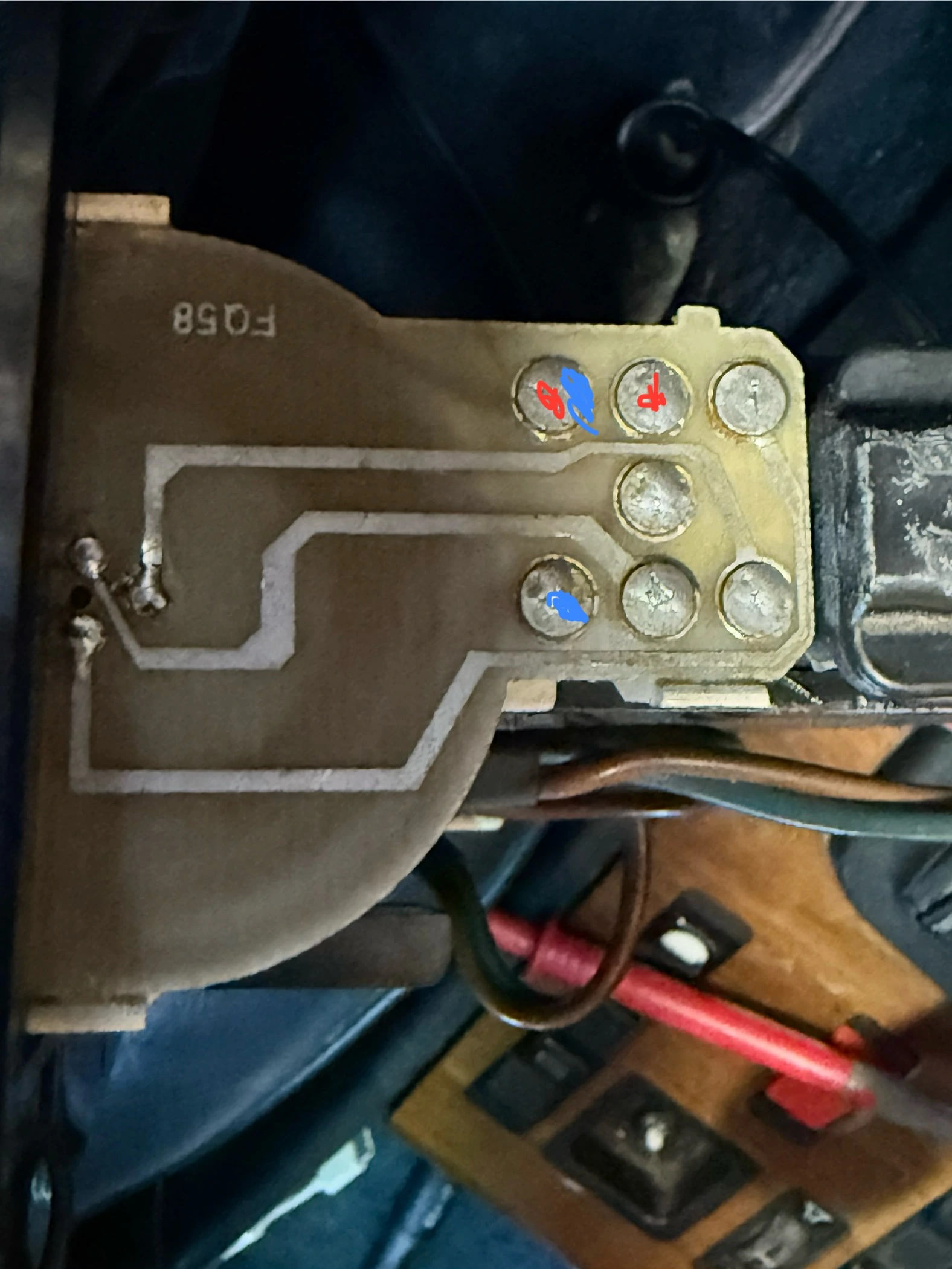
Upon reflection the top right pin should probably also have been marked blue CHECK THIS
I think that this article is long enough now, I’ll have a second installment of the Automatic Climate Control saga in the future.
-
This is because these Mercedes diesels use vacuum to shut off the fuel pump and if you keep giving a diesel cycle engine “fuel” it will keep running, fuel could be anything like diesel, peanut oil, veggie oil, 0W-20, or its own engine oil. ↩︎
-
SVG diagram also available: https://trythistv.com/wp-content/uploads/2024/03/Mar2024vacdiagram.svg ↩︎
-
In 2026 computer is a very strong word for a box with 8 op-amps and a few RC oscillators. But less is more and we have forgotten that. There are no CVEs in this computer! ↩︎